Noise & public health
Her research into noise-induced hearing loss fed directly into policy. She has advised the government on the laws governing noise pollution in Dhaka.
Biography
Professor Husne Qumer Osmany has spent her career in the ear, nose and throat department at Dhaka Medical College: operating on head and neck cancer, directing the hospital’s Cochlear Implant Programme, and teaching the students who’ll come after her. In 2024, she became the first woman appointed to a professorship in the subject in Bangladesh’s government sector.
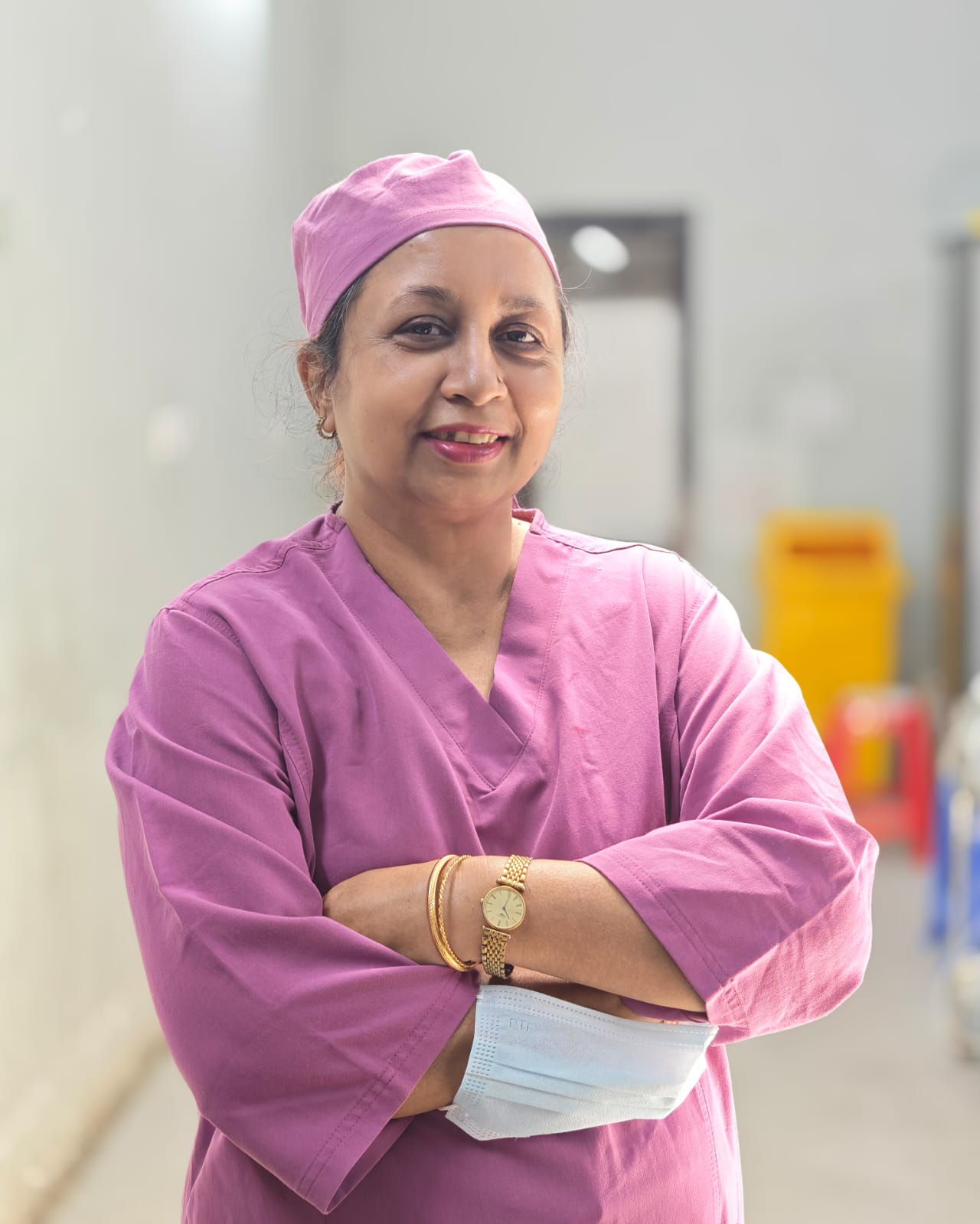
She grew up in Dhanmondi, Dhaka, in a big joint family that always seemed to have guests at the table. Even in a small house, there was room for more people, and it was always enjoyable. Medicine was the plan from childhood: her father had wanted to become a doctor himself, but his family’s finances made that impossible, and fulfilling that dream for him became part of what carried her forward. So did a family friend, Dr. Shahela Khatun, whom she’d watched at work since she was a girl.
She studied at Sir Salimullah Medical College, Dhaka, from 1991 to 1998. Otolaryngology had interested her since childhood, thanks in part to Dr. M. Allauddin, a fellow Sylhetti like her family. It was settled for good in medical school, where two teachers, Dr. Md. Abdullah and Dr. Prangopal Datta, made the subject feel like the one to pursue. She wanted to do surgery, but she also wanted the time a surgical career doesn’t always leave for raising a child. ENT gave her both.
She completed her FCPS in Otolaryngology, training at Sir Salimullah Medical College (2003–2005) and at Bangabandhu Sheikh Mujib Medical University (2005–2006).
Assistant Professor in 2013. Associate Professor in 2017. And in 2024, Professor of Otolaryngology: all at Dhaka Medical College, the same department where her first academic post, back in 2010, had been as a Lecturer in Anatomy. She was proud of the professorship, and thought, too, of her parents and parents-in-law, none of whom lived to see the day. The following year, in 2025, the government appointed her Programme Director of the hospital’s new Cochlear Implant Programme.
When she entered private ENT practice, only five women in Bangladesh were doing the same. Today the field counts somewhere between fifty and sixty otolaryngologists across the public and private sectors: still more men than women, but nowhere near as lopsided as the field she started in.
She teaches fourth- and fifth-year MBBS students. Her unit at Dhaka Medical College takes new patients on Sundays, operates on Tuesdays, and runs the cochlear implant clinic on Wednesdays. Evenings not on the wards go to chamber, at Lake View Clinic or York Hospital. At home, she reads, tends her plants, and is closely supervised by nine cats.
She was the first. Others followed.
Five women were practising ENT privately when she started. Fifty to sixty otolaryngologists practise across Bangladesh today.
Present appointments
Career
Dhaka.
Sir Salimullah Medical College (2003–2005), then Bangabandhu Sheikh Mujib Medical University (2005–2006).
Dhaka Medical College, her first academic post.
Dhaka Medical College.
Dhaka Medical College.
Dhaka Medical College: the first woman appointed to a professorship in the discipline, in Bangladesh’s government sector.
A first in the government sectorDhaka Medical College Hospital, a government appointment.
Teaching, operating and consulting, with chambers in Gulshan and Banani.
Credentials
Beyond the clinic
Her research into noise-induced hearing loss fed directly into policy. She has advised the government on the laws governing noise pollution in Dhaka.
Thesis adviser to eight FCPS and MS trainees in otolaryngology, the surgeons learning to do this after her.
Reading, her plants, and nine cats who supervise all of it.